
Oxfam and the Guardian launches interactive documentary on Bangladesh
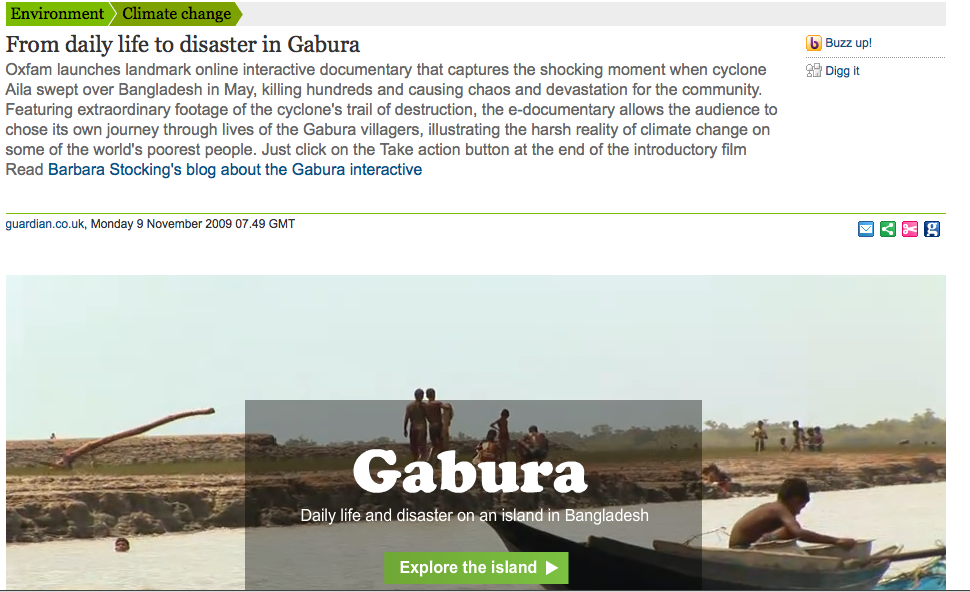
Written by duckrabbitIts brilliant that Oxfam have put so much effort into creating an online documentary about the effects of climate change on the people of Bangladesh.
On the upside Oxfam used a local media team who were on the scene when cyclone Aila hit. Respect. There’s also a clear way of responding by sending a message to the team who are traveling to Copenhagen on the UK’s behalf to negotiate a deal. I think it’s really important that charities give people some way to respond other than putting their hands in their pockets. Sure that’s one way of helping but it’s more important that people are engaged in these issues, that they aren’t given the sense that charitable giving can lead to any kind of widespread meaningful solution to the serious problems of inequality in this world.
On the downside there’s no way that I can embed any of the stories on duckrabbit or A Developing Story, limiting the ability of the documentary to travel around the web. This is surely a mistake if Oxfam are serious about getting the message out (and clearly they are). I’m not talking about dumping videos on youtube, but offering a fully embeddable feature that people can host on their blogs and websites. Human Rights Watch have already started to experiment with this, to great effect.
I know for a fact that when we embed a video on duckrabbit many more people watch it then if we just pop up a link to a video on an external website. Generally though, to get on duckrabbit or a similar website, the quality of the content needs to be decent, and up till now that has been the major problem for NGOs, their communications are often more of a turn off than a turn on.
All in a ll huge respect to Oxfam for this innovative work.

Author — duckrabbit
duckrabbit is a production company formed by radio producer/journalist Benjamin Chesterton and photographer David White. We specialize in digital storytelling.
Discussion (3 Comments)
For me the most interesting thing that Oxfam UK have done here is make the focus of the activism the video. Rather than just write to your MP or present written research they are pushing a visual product. I can’t say I have seen too much of this (the only thing that jumps to mind is another Guardian piece with ActionAid aimed at a G8 summit a couple of years ago with visuals provided by Gideon Mendel, but I don’t think that was open to public action in the same way this is?). Also worthy of credit is the diversity of subjects covered by the various videos (which reminds me a little of the Save the Children UK site ‘This is Kroo Bay’ – though this featured participatory content too). Here Oxfam not only present ‘disaster’ but contextualise life for the people living in the region, and make connections between their everyday lives and how it is impacted by the changing environment. I agree that not being able to embed this is a hindrance and HRW are to be congratulated by their recent experiment.
Rob
The Rights Exposure Project
True about not being able to embed, but the whole thing is really impressive. I’ve only watched about a quarter of the little clips so far but I really like the way it’s been presented in a digestible way. And I think it’s great that local journalists put it together – it’s a very positive example. I think as well, from experience, a westerner would have found it quite difficult to work there without becoming a spectacle in themselves and drawing a constant crowd….