
Climate change Bangladesh
Written by David WhiteG’day.
Couple more pics for you from Bangladesh. The first one shows the boat we were on approaching the village and island of
Jafar Koloni, Madanpur union. The people who live on the island have to build their huts on stilts because the water levels rise so high that they have no land for 8 hours a day. We arrived at low tide, hence the visible land. On our return a few hours later the hut in the background was the only thing visible above the water.
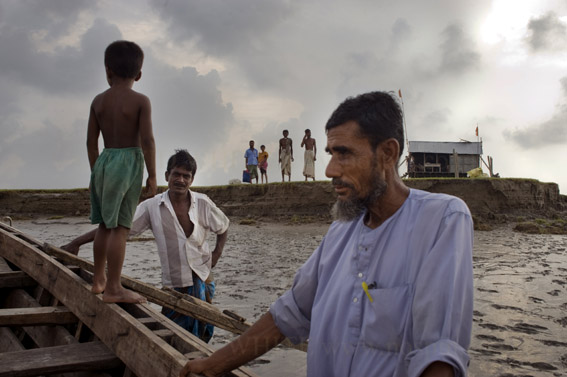
Approaching the village and island of Jafar Koloni,Madanpur union. The people who live on the island have to build their huts on stilts because the water levels rise so high that they have no land for 8 hours a day.
The second pic is a shot of some youngsters reflected in a pool that had formed due to locals removing mud to build a barrier against the rising water levels, Alimoddi, Bhola island. Now. I don’t know if what I have done here is ‘legal’ or not in a photojournalistic context..probably not, can you tell how I’ve been naughty? this could cause a major split in the international world of photojournalism. Agencies will be divided, photographers will be fighting each other in the streets, throttling each other with their kefiyehs. And all because I turned the image upside down. Whose side are you on? What is the world coming to? I think we should get more worked up about me turning the pic upside down than we are about climate change.
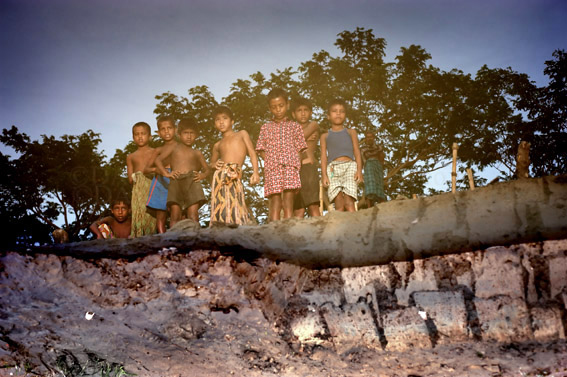
Climate change, Bangladesh, 9.2009. Trying to rebuild village defences against the rivers, Alimoddi, Bhola island...children reflected in the pools created when locals dig mud to shore up their defences against the rising water levels. This image has been turned upside down.
Just to clarify…there was rather a large dose of irony in that last sentence…
DW
Discussion (2 Comments)
David you will be a pariah on lightstalkers. they will try to hit you with their handbags.
Did you see this on today’s Guardian? there’s a second part tomorrow http://www.guardian.co.uk/environment/video/2009/nov/30/bangladesh-climate-migration
I’ve just watched it. It has captured the reality very well. Thanks for the link.