
Writing Here:

duckrabbit
David White
Ciara
John Macpherson
Peter
Sara Trula
Carl Pendle
Joni Karanka
Mike Lusmore
Julian Lass

What they say about duckrabbit:

'One of the hazards of publishing a well-known photojournalism blog - getting multimedia like yours, where the photos are both powerful and moving, and I end up in tears at my desk.'

Alan Taylor, Boston Big Picture)

'David White's multimedia work with duckrabbit is very exciting.'

Kate Edwards (Guardian Magazine Picture Editor)

'I am a fan of duckrabbit. I am not a fan because I agree with everything Ben has to say, but because he says it without frills and then will spend the time necessary to engage the consequent discussions. Such commitment is a priceless commodity.'

Prison Photography

'I met one of them at an academic conference in the summer. He was the sanest person there, but sure enough by damn gadnabbit ruffled more than a few fluffed up peacock feathers.'

The Photography Pages

'If you haven't seen the duckrabbit blog on multimedia you should.'

Stephen Alvarez

'duckrabbit has done another jaw-dropping job with Condition Critical, a highly commendable and important project for Medecins Sans Frontiers.'

The Travel Photographer

Hiroshima..the lost photographs.

Here is a very powerful piece..

All about a set of found images of the devastation wrought upon Hiroshima in 1945.

“The lack of visual evidence of the atom bomb‚Äôs effect has helped us to forget its devastating impact. To see is to remember. Up until now, there have been few publicly available images of what happened on the ground when the first atomic bomb exploded. As a result, Hiroshima has become, as the novelist¬†Mary McCarthy wrote in 1946, ‚Äúa kind of hole in human history.‚Äù

“Since the invention of the camera in 1839, photography has marched in lockstep with death, especially death experienced in war. Starting withAlexander Gardener‚Äôs and¬†Matthew Brady‚Äôs images of the American dead at Gettysburg, through¬†Robert Capa‚Äôs visceral images of the Spanish Civil War (made more immediate as a result of the camera having been freed from the restraints of the tripod), images of death and destruction have served to document war‚Äôs brutality.”
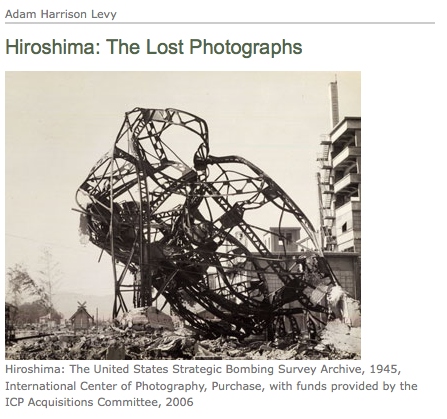
A very powerful and evocative piece.

dw

Spread the word
  • Twitter
  • Facebook
  • Digg
  • del.icio.us
  • Google Bookmarks

Related posts:

  1. And death came along …
  2. When photographs aren’t enough
  3. No Light Lost On The Blind Boys

1 comment to Hiroshima..the lost photographs.

  • duckrabbit

    I’ll write a post on this at some point David, but for me its like a new form of history started with photography … and that photography has never served humanity so importantly as when documenting crimes against humanity and in particular war … which is why world war 1 and onwards are so visceral.

    When we remember Hiroshima, we remember an image, the mushroom cloud.